On Friday, June 14, 2019, President Donald J. Trump announced the expansion of Health Reimbursement Arrangements (HRA) to benefit small businesses and their employees. Keeping with promises made in Executive Order 13813 (October 2017) and during his campaign, the administration has worked tirelessly with the Departments of Health and Human Services, Labor, and Treasury (the Departments) to return consumer choice and affordability to employer-sponsored group health benefits with the new Individual Care HRA (ICHRA).
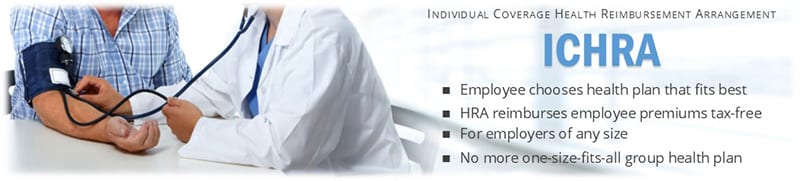
Advantages for employer, employees
Premium reimbursement, Any number of employees
Traditional group health plans, Same terms requirement, Employee classifications, FSA & HSA coordination
Plan design options, Launch your ICHRA, Prep for success
Employee elections, Proof of coverage
Non-standard coverage types, Coverage types that cannot be integrated, Spouse group health plan exception
Substantiation, Medicare, Section 125 plan for balance of premium
ALEs only

Health Reimbursement Arrangements are employer-funded accounts that reimburse employees for eligible medical expenses. No employee contributions are allowed.
Since an HRA is funded only by the employer, the employer sets the rules of the plan. At least that’s how it was until ObamaCare came along.
The Affordable Care Act (ACA, 2010) deconstructed HRAs to align them with mandates in the law.
First, employers could no longer provide an HRA that reimbursed employees for medical expenses unless the employer first provided a group health plan.
Then, the employer-sponsored group health plan had to meet the essential benefits and no lifetime limits requirements applied under the ACA.
This put HRAs out of reach for most small employers, and persons working for these businesses lost health coverage entirely.
Those under the large employer mandate (50+ employees) had to buy into the more expensive ACA cookie-cutter group health plans. Year after year, premium hikes cut into the company’s ability to grow and operate efficiently as well as their employees’ family budgets.
In his announcement, President Trump said that the individual health coverage market will end up seeing a 50% increase, which will have the result of lowering individual health coverage premiums.
Also, it is expected that 90% of employers implementing the new ICHRA will be companies with 20 or fewer employees.
The ICHRA works much the same as other HRAs, with the following important differences:
Most HRAs reimburse for eligible medical expenses that are not health plan premiums, with the exception of a policy that only covers excepted benefits (vision and dental). It is the employer’s responsibility to select, sponsor, and maintain a group health plan for employees with all the accompanying requirements of ERISA and COBRA.
The ICHRA reimburses participating employees for individual coverage health plan premiums as well as other medical expenses. And, since the employee chooses, purchases, and maintains their health plan, ERISA and COBRA do not apply to an ICHRA.
While the QSEHRA was a boon to the “qualified small employers” that fit within its “fewer than 50 employees” rule, the ICHRA is available to employers of any size.
ICHRAs are designed to reimburse employees for the purchase of individual coverage purchased on the open market or on an ACA exchange.
However, employees buying health coverage on an exchange will not be eligible for a premium tax credit.
There is a provision within the ICHRA which allows an employee to opt out of reimbursements from the ICHRA at least once every plan year and at termination of employment.
Opting out of the ICHRA does not mean the employee will be eligible for a premium tax credit as a result.
The premium tax credit is only available when health coverage under the ICHRA offered by an employer under shared responsibility rules (ALEs with 50+ employees) is determined to be unaffordable according to ACA guidelines.
An employer may not offer an ICHRA and a traditional group health plan (GHP) to employees within the same class.
However, an employer may offer an ICHRA to one class of employees and a traditional GHP to another class.
Also, a traditional GHP may be grandfathered for current employees while all new employees as of a stated date (January 1, 2020, or later) are offered only the ICHRA.
An ICHRA must be offered on the same terms to all employees within a set class. This refers to the amount of the benefit, rollover rules, and other aspects of the ICHRA plan design for that employee class.
An ICHRA allows businesses to set classes of employees according to the following statuses:
Higher benefit amounts are allowed within a class of employees for older workers and those with more dependents.
Employers offering only the ICHRA to workers within all employee classifications, the minimum class size rule does not apply.
However, when an employer offers a GHP to one or more class of employee and an ICHRA to one or more other classes, the minimum class size rule applies to classes being offered the ICHRA. The minimum class size ranges from 10 to 20 employees, based on total number of employees.
HIPPA privacy rules apply to an ICHRA:
Employers may continue to offer a health Flexible Spending Arrangement (FSA) and/or a Health Savings Account (HSA) to employees with an ICHRA.
The ICHRA qualifies as the “other group health plan coverage not limited to excepted benefits” necessary for health FSA participation.
An individual considered eligible to contribute to a Health Savings Account must be covered by a high deductible health plan (HDHP) and have no other coverage that will pay the HDHP deductible. An ICHRA may reimburse employees for HSA-eligible HDHP premiums.
When an ICHRA is designed to reimburse individual health insurance coverage premiums and only medical expenses paid once the HDHP deductible is met (a post-deductible HRA), it does not disqualify an otherwise eligible individual.
However, when the ICHRA is not limited to covering individual health premiums and post-deductible medical expenses but can also reimburse expenses that fall within the HDHP deductible, it is not HSA compatible.
Since some employees may choose to purchase an HSA-compatible HDHP while others will choose non-HDHP individual health coverage, employers may offer both regular and post-deductible (HDHP) individual coverage HRAs to workers in an employee classification so long as it is otherwise offered on the same terms.
When an employer offers the ICHRA with both the health FSA and HSA, the health FSA must also be set up as a post-deductible model for individuals with an HSA-compatible HDHP.
All benefit plans must have a written plan document to qualify for tax-favored treatment of premium payments, contributions, and reimbursements. This is in the IRS rules for all HRAs, including the individual coverage model.
The plan document states all of the information about the plan including how it works, amount of benefits, who sponsors the plan (employer), who administers the plan (sponsor or agent), and all of the legal information required by the IRS, DOL, and ACA.
It is a fairly complex document, and that’s why we’re here. Core Documents provides everything an employer needs to establish a tax-saving benefit plan in one convenient and affordable package. Our Core ICHRA plan document package will be priced in line with our other HRAs at $199, and that’s a one-time fee, not an annual subscription.
But first, there are some decisions an employer has to make about their individual coverage HRA, so it can be stated properly within the plan document.
As you read more about the options (below), detailing the HRA may seem a little daunting at first. Make it easy by taking up our offer of a complimentary, no-obligation plan design consultation.
We hope you will contact Core Documents’ certified plan consultants by phone at 1-888-755-3373, or send your questions in an email.
The best way to begin is by defining the classes of employees that will be used in the ICHRA to further decide plan benefits. As explained in Same Terms (under ICHRA rules), classes can be set by several criteria and combinations of criteria.
Will part-time employees be eligible to participate? What about seasonal or temporary workers? Will the company grandfather existing employees under the current traditional health plan while new hires are provided the ICHRA? Do participants with more dependents receive a higher benefit?
Some elements of a plan can have a variance within the same class (a higher benefit for older workers is one example) while most other differences in benefit terms and amounts have to be assigned separate classes.
All of this is covered in detail in the Same Terms rule section.
Once you have set up the employee classes, set the plan rules for them.
The individual coverage HRA is the most flexible of all plan models. The employer provides all the funding, so the employer makes pretty much all the choices in plan design.
Here are just a few of the options left open to the company sponsoring the plan (all can vary by employee classification group):
Amount of HRA benefit per year
With no minimum or maximum funding limit set by the rules, the HRA benefit amount is entirely up to the employer.
Pre-funding
The annual HRA benefit can be made fully available to participants on the first day of the plan year, or credited on a monthly basis.
Rollover option
What happens to unused funds at the end of the year? It’s up to you.
Coverage limits
Generally, an ICHRA will reimburse for all eligible medical expenses, but a company can set parameters so that the HRA only reimburses for the individual health coverage premium integrated with the plan, or for the premium plus only post-deductible expenses (for participants with Health Savings Accounts).
Like all HRAs, individual coverage models run on a 12-month plan year. Just when that plan year begins and ends is up to the employer.
Most plan years begin January 1 and end December 31; however, it can be any 12-month period. Some companies correlate the HRA plan year with their fiscal or tax year begin and end dates.
A short plan year is available for the first period. For example, a first plan year beginning March 1 and ending December 31, with all future plan years beginning January 1 and ending December 31. This can help an employer who wants a standard calendar plan year but is not able to begin a new ICHRA until later and similar circumstances.
Every year, Americans are permitted to make changes to individual coverage health plans during the health insurance open enrollment period that runs (usually) November 1 through December 15.
This is the only time of the year that health insurance can be purchased unless the participant or a covered dependent has a qualifying life event that opens a special enrollment period.
For the first plan year of an ICHRA, this is not a problem because a special enrollment period exception is made for participants gaining access to an ICHRA for the first time.
However, participants wanting to make a change in their individual coverage provider in later plan years will only be able to do so during the standard insurance open enrollment period.
It is not required but may be helpful for employers on non-calendar plan years to formally remind employees of the open enrollment period prior to the January 1 that falls within the HRA plan year so that any wanting to change their individual health coverage will not miss the opportunity.
Companies that presently sponsor an employee group health plan and do not plan to grandfather it for existing employees must cancel the policy prior to the start of the ICHRA plan year (January 1, 2020, or after).
The Core ICHRA plan document package will be available for only $199 (electronic distribution) as soon as the rules allow that individual coverage products are released for sale.
Core Documents plan document packages come to you for a one-time fee. There’s no required renewal or subscription fee. You only pay for an update when one is needed, and then at a reduced price.
You may choose either the standard electronic delivery service (.pdf) or a deluxe version that adds a printed binder for your convenience. Either way, the .pdf comes to you quickly, usually within the same business day.
If you would like to receive an alert when there is more ICHRA news and when the Core ICHRA plan document package is available, please register here.
The order form for the Core ICHRA will be similar to our other HRA plan document packages. You may download and print that form to see the type of information requested and make preliminary notes.
As always, feel free to contact us via email or phone if you have questions.
A Core ICHRA plan document package includes:
Keep it on file and available in case of an IRS audit, the DOL requesting a copy, an employee asking to view the document, and for administrative guidance.
The plan document is not filed with the IRS, DOL, or any other government entity.
(Employers may find it convenient to include the ongoing substantiation of coverage form as well.)
Election and substantiation forms must be signed by employees, returned to the employer, and kept on file
The success of your ICHRA will depend in part on its acceptance by the employees eligible to participate. Telling an employee that the company will reimburse them for their purchase of individual health coverage may not be enough to get a high rate of buy-in, especially for individuals who have not looked into buying health insurance before now.
The required written notice informs employees that they need to purchase individual health coverage from either the exchange or open market, and HHS promises additional resources to help individuals offered an ICHRA understand the concept of the ACA affordability provision and how that determines eligibility for a premium tax credit if they opt out of the ICHRA. This promised help will also address coverage dates, the annual enrollment period, and special enrollment periods.
There is no promise in the rules about helping employees with making a decision on purchasing individual health coverage.
Employers are forbidden by law to sponsor or endorse specific individual health coverage providers, agents, or plans.
However, an employer may provide general information on how to find a provider or agent, or what to look for in an individual health coverage policy.
This help can be as simple as providing a list of several online resources:
| Resource | Provided by | Description |
| HealthCare.gov | Choosing a health insurance plan can be complicated. Knowing just a few things before you compare plans can make it simpler. | |
| Pick the Best Health Care Plan for You | AARP | What you need to know about buying medical insurance on your own. |
| The Basics of Choosing a Health Insurance Plan | The Balance | Whether you choose a group plan or an individual plan, there are important choices to be made. |
| Your Step-by-Step Guide to Choosing a Health Insurance Plan | NerdWallet | The health insurance landscape can be tricky to navigate. Here’s a start-to-finish guide to choosing the best plan for you and your family. |
| PlanFinder | HealthCare.gov | This Plan Finder website is provided by the federal government to help you find private health plans available outside the Health Insurance Marketplace. |
| eHealthInsurance | eHealth | Our online tools, free quotes, and licensed agents are here to help you find a plan. |
Employee election of coverage is for the duration of the plan year and may only be changed during the plan’s annual open enrollment period unless the participant wishes to opt out of the ICHRA or qualifies for a special enrollment period.
The employer must offer, at least once per plan year, an opportunity for participants to opt out of the ICHRA.
A special enrollment period applies when a participant or covered dependent experiences a life event that can significantly impact their health coverage. These include a birth, death, divorce, and similar events. For more information, see Getting health coverage outside of open enrollment.
An individual coverage HRA must require proof of individual health coverage no later than the first day of the plan year. The employer may set any reasonable date that meets this rule.Also, when an employee or dependent becomes eligible after the first day of the plan year, initial substantiation of coverage is required within a reasonable timeframe as determined by the employer.
The employee must provide ongoing substantiation of individual health coverage with every request for reimbursement for the participant and their dependents throughout the plan year.
The IRS has provided model forms for both annual and ongoing substantiation. View the annual form here, and for the ongoing form, here.
These forms and the written notice are customized in your Core ICHRA plan document package.
Cut through all the rhetoric and speak directly to an IRS Section 125 Plan expert Certified In Flexible Compensation.
P.O.Box 14538, Bradenton, FL 34280 Office: 501 Village Green Parkway, Suite 11, Bradenton, FL 34209
Toll Free: 1-888-755-3373 or 941-755-3373
Fax: 941-795-4802
Email: coreservice@coredocuments.com
